

BY COLLEEN KEANE
SPECIAL TO THE TIMES
ALBUQUERQUE – In the 1930s, Angela Ashley, a Diné weaver from Burnt Water, Arizona, lost most of her sheep to the Bureau of Indian Affairs livestock reduction.
“She lost hundreds of sheep,” says Eric-Paul Riege, Ashley’s great-grandson.
Riege is Naaneesht’ézhi Táchii’nii (Black Charcoal Streak of Red Running into the Water People), born for Béésh Bich?ahii” (Metal Hat People-German).
Recalling stories by his mother, Retha Duffy-Riege, he said the colonial government intervention devastated his great-grandmother.
“This was her livelihood. She depended upon it,” he said.
After their sheep economy was ruined, Riege’s family eventually moved to Gallup where he grew up.
Now, in his early 20s, Riege is completing a bachelor’s degree in fine arts with a minor in Navajo linguistics at the University of New Mexico.
Following in his great-grandmother’s footsteps, Riege is a fiber artist who works with a variety of natural materials and dyes. He’s also a performance artist and creates digital presentations.
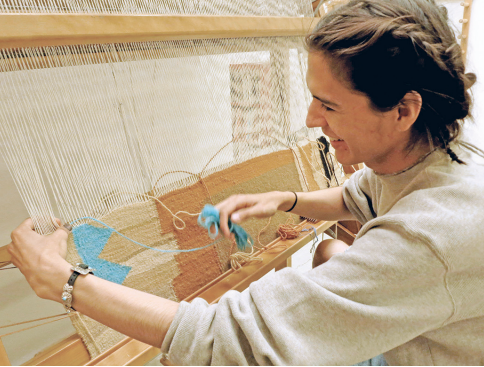
As he works on a weaving in Masley Hall, an art building on the north side of campus, he shares more of his family’s history.
“There’s a belief that if you don’t finish a weaving, your life will not continue the way you want it,” he said.
Riege attributes his great-grandmother’s long life to her many beautifully woven weavings.
Passing away in 2005 when Riege was 10, Ashley lived to be 101.
Turning to the weaving he’s working on, Riege says that his work brings back good memories for his mom.
“When I beat the loom and my mom hears it, she says it takes her back 50 years when my great-grandmother was weaving and she was rolling balls of yarn for her,” he said.
When his mom helps him with a weaving, Riege says with a smile, the process creates a special bond.
“Every inch of the yarn goes through her hands and then goes through mine. I see that as a collaboration,” he said.
As he grasps a string on the loom, Riege relates how weaving becomes the teacher.
“If there’s a gap in your weaving, it’s telling you to slow down,” he said. “At the edges, if you pull a little too hard, that’s a sign that you’re angry. You never want to be angry when you’re weaving, because you’ll be able to see it all over the place.”
When this most recent work is finished, Riege says it will reflect both the federally imposed boundaries of the Navajo Nation and the much wider ancestral ones.
Riege’s weaving is one piece of his large fiber art installation entitled “Dibé Hozho Yitl’o” that will be presented during the “Arts Unexpected,” 2017 festival.
The pop-up art installation and performance across the UNM Albuquerque campus takes place Friday, April 28.
Dibeé Hozho Yitl’o (“sheep weaving happiness”) can be found in front of Zimmerman Library (Smith Plaza) from 9 a.m. to 3 p.m.
Riege’s installation is his bachelor’s degree honors thesis.
As he adjusts the loom and then rhythmically beats down on the colored strings, he says his family’s stories are woven into the exhibit.
“These stories have created my identity as an indigenous person,” he says adding that the project has given him the ability to navigate his life through hozho, the Navajo philosophy of being connected to each other and finding balance in life.
Sharing that sense of hozho, the 6-by-11-feet fiber structure will give visitors the opportunity to enter a hogan, sense its beauty and the spiritual connection to the weaver.
The exterior will take visitors through the weaving process. Inside they will see work created by his great-grandmother, aunt and several of his own.
Along with the installation, Riege will present a one-person performance between 11 a.m. to 1 p.m.
His performance will bring to life the events of the 1930s that altered his family’s lifestyle and history.
Picking up a curved fiber mantle made out of rug that’s been in his family for many decades, Riege puts it over his shoulders.
Then, walking a little bent over, he shows how he’ll use sticks for legs and play one of his great-grandmother’s brave sheep that was able to escape capture during the BIA’s livestock reduction.
“He will be exploring; looking for my great-grandmother and her hogan,” he explained.
During the performance, Riege says, “This will be a moment for me to meditate and to celebrate my family.”
Riege, the first in his family to earn a bachelor’s degree, will graduate in May.
“I’m excited it feels really good to graduate,” he said. “With everything my family has done for me, it’s a group achievement, not an achievement as one.”
Riege says his parents, Retha and Ken Riege, nurtured his academic endeavors.
“They are really proud of the work that I do,” he said.
Another opportunity to meet Riege and see and experience his show is from June 5 to 16 at the CFA Downtown Studio (4th Street and Central). An opening reception is June 9 from 6 to 9 p.m.
After he graduates, Riege plans to work with Orlando Walker, Diné, at the Shallow Gallery, a space for indigenous artists in Gallup located on Coal Avenue.
There, Riege says, he will keep sharing what he’s learned from the women in his family.
“Hozho – walk in beauty!” he exclaims.
Information: ericpaulriege. com and artsunexpected.unm. edu.
SUBMITTED
UNM fi ne arts student Eric-Paul Riege, Diné, works on a weaving that will be integrated into his larger fi ber art installation during a one day pop-up art experience in front of Zimmerman Library in Albuquerque on April 28.