

FROM PAGE 1
The new day was created through a city ordinance sponsored by City Councilor Rey Garduno (Dist. 6) that abolished Columbus Day, historically recognized on the second Monday of October, replacing it with Indigenous Peoples’ Day of Resistance & Resilience.
Speaking to the people, Garduno expressed camaraderie and compassion in struggles for pay equality, public safety and human rights.
“Colonization is not just taking over (land), but it also tries to take over what we think and how we feel about ourselves. We come from the same earth. We are all allies. We can attain what we want. Let’s work together (to bring down oppression),” he told them.
He expressed respect for the tribal communities that have ancestral homelands in the boundaries of the city.
“Indigenous folks have been here a lot longer than the rest of us; 500 years is nothing compared to how long the people of the land have been here,” he said.
In response, Garduno was given thunderous applause for the part he played in opening a new chapter in the city’s history.
It’s one chapter of many that need to be rewritten by Native Americans, according to Amanda Blackhorse, the advocate who took up the fight with Suzan Harjo to eliminate the Washington, D.C. football team’s logo and mascot that Blackhorse said dehumanizes Native Americans.
“They say horrible, horrible things,” she said, referring to comments made at sport events when she and others speak out.
Blackhorse added that the attitudes like the ones expressed at Washington games are the same dehumanizing attitudes that were behind the murders of Kee Thompson and Allison Gorman, two members of the Navajo Nation who were brutally bludgeoned to death while they slept in an empty lot last summer. Three Hispanic youths are accused of their murders.
“When we (Native Americans) are looked at as symbols and cartoons, we are not looked at as human beings. When that happens, people feel they can treat us any way they want,” she said, mentioning that the two home- less men were said to have been murdered for “fun and games.”
“We have to rewrite our own narrative. We have to decide how we want to be represented in the world,” she added.
Foster, talking to about 100 students earlier in the day at the University of New Mexico during another event honoring Indigenous Peoples’ Day, told the group that attitudes like the ones that created the Washington logo and mascot are like an infection that needs to be healed.
“We have to go back to our Dine ceremonies to (heal the negativity that comes from them),” he said.
Speaking as a community member and a member of the Red Nation, the group that pulled the events of the day together, Dine historian Jennifer Denetdale said that the march and rally is one step of many to raise collective consciousness.
“Colonization has not end- ed. We continue to struggle to protect the sovereignty of our nations, lands, natural resources and communities,” she said.
Duane “Chili” Yazzie, Shiprock Chapter president, speaking in the civic plaza where the march ended up, told the supporters of Indigenous Peoples’ Day, “The equilibrium of the world is precariously out of balance. The damage must be repaired. We cannot ignore the pollution and the scarcity of water, the world over. These adverse changes impact us all. It is our responsibility for future generations to defend our Mother Earth.”
Recognizing the huge numbers of people who came out to show support, Jewell Hall, a long time Albuquerque civil rights leader, said that the day was a landmark event.
“Today’s actions say that we are united in our support of our Native American sisters and brothers. The genocidal legacy of Columbus against Native American people must be reject- ed and abolished,” she said.
Jonathan Nelson from Shiprock said that he’s doing his part as an educator in a university setting and as an artist to make change happen.
Creating a graphic that depicts a cross between a Cleveland Indians ball club logo and the image of Tonto, depicted by Johnny Depp in the movie The Lone Ranger, Nelson took out the eyes to show that the image “has no soul.”
Nelson wants these images to be the next to be done away with after the Washington mascot and logo meet their demise.
Kayleen Scott, from the Navajo community of Indian Wells, Ariz. said that she and her son came to the march to raise awareness of health issues, especially around uranium mining areas among the Dine people.
A Dine teacher who said she had to follow state-mandated history content that includes teaching about Columbus, said that now as a retired teacher she’s supporting Native American curriculum that tells the indigenous story.
In looking over the huge crowd Dine historian Zonnie Gorman said, “It’s great to see the soli- darity and the mix of cultures and people who are supporting Native issues.”
As night fell, a girl about 10 years old, took up a colored piece of chalk and pressing down hard, left the main message of the day on the floor of the civic plaza.
It read “Indigenous Resistance!”
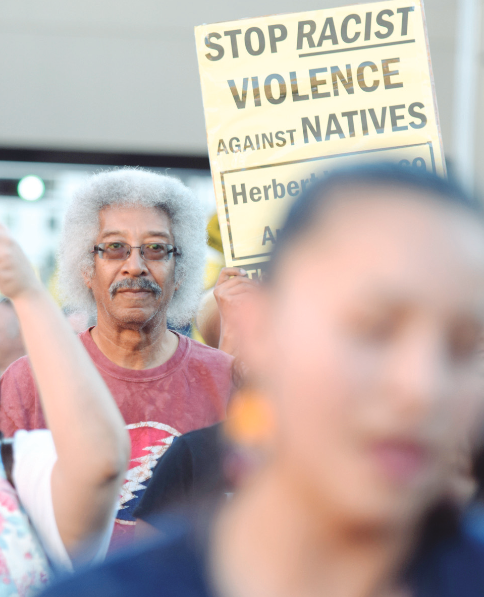
Founder of the Gathering of Nations Powwow Derek Mathews marches in the first ever Indigenous Peoples Day march and rally in Albuquerque on Monday.