

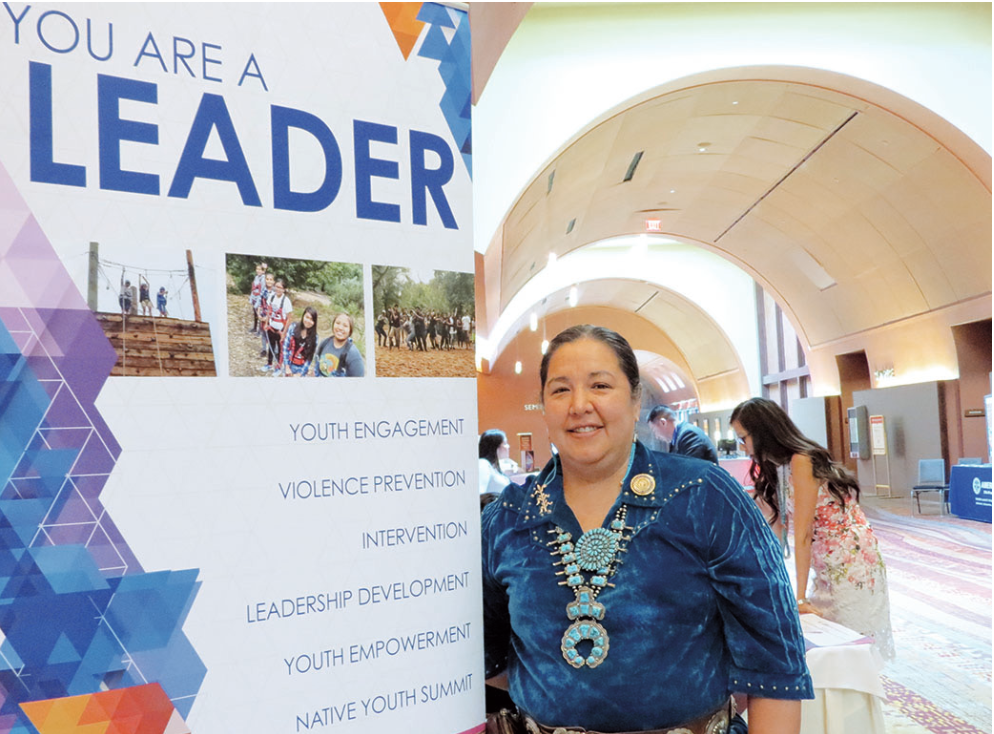
Navajo Nation Council Delegate Amber Kanazbah Crotty stands near the registration table for the 2017 Tribal Leaders Summit held March 30 and 31 and hosted by the Coalition to Stop Violence Against Native Women.
BY COLLEEN KEANE
SPECIAL TO THE NAVAJO TIMES
ALBUQUERQUE – Nearly all of New Mexico’s 22 tribes were represented at this year’s Tribal Leaders Summit hosted by the Coalition to Stop Violence Against Native Women.
The annual summit emphatically addressed the alarming rates of domestic violence and sexual assault perpetrated against Native American women.
“During the last few years tribal leader attendance has skyrocketed,” said Deleana OtherBull, executive director of the coalition.
OtherBull said that 19 New Mexico tribes were represented at the summit held March 30-31 at the Isleta Resort and Casino. Participants included tribal leadership and staff from many of the pueblos, Mescalero Apache Tribe, Jicarilla Apache Nation and the Navajo Nation.
Representing the Navajo Nation, Council Delegate Amber Kanazbah Crotty (Toadlena/ Two Grey Hills, Red Valley, Tse’alnaozt’i’i’, Sheepsprings, Beclabito, Gadiiahi/To’Koi) said she attended because she wants to see a stop to the violence.
“When we look at these is- sues, it’s nationwide,” she said. “The high rate of violence that our children and our women are suffering is not just on the nation. It’s in urban area.”
In addition to hosting the summits, coalition offers educational resources, training, assistance with policy development and publishes reports on domestic violence incidences and impacts.
The New Mexico data the coalition shared at the conference can’t be ignored:
• Four in five Native women are affected by sexual or domes- tic violence.
• More than half of the violence towards Native women is sexual violence.
• Most injuries for women18-44 are caused by domestic violence.
• Domestic violence is the 3rd leading cause of homelessness among families.
• A third of all New Mexico’s children have witnessed domestic violence.
OtherBull said shared resources and networking are key to stopping the violence.
Tanya Devon Torres, Cochiti Pueblo’s Indian Child Welfare program director, added, “It’s important for tribal leaders to participate because they’re the ones who make the decisions for our sovereign nations. They are the fathers of all our communities. They are tasked with the safety of all the people.”
Speaking to the Navajo Times, Crotty agreed.
“Tribal leadership showing up says, ‘This is a priority!’” she said.
She attended to find out what interventions work best in tribal communities and to identify training opportunities for Navajo Nation social service staff.
“We have Navajos who are graduating with MSWs. We want them to have resources,” she said.
“Every tribal leader needs to be aware of the summit,” noted Cochiti Pueblo Governor Eugene Herrera who also spoke to the Times.
Herrera said the summit provided many opportunities to collaborate with organizations that provide advocacy and support.
“There’s a lot of help out there,” remarked Herrera. In her session, Corrine Sanchez, Tewa Women United executive director, provided several ways that tribal communities can create change:
• Collect statistics on assault and domestic violence.
• Volunteer to sit on state and tribal task forces.
• Explore ways to address budget constraints.
• Advocate for local, regional and national policies that support prevention and intervention.
Speaking to a group of about 100 participants, who included tribal leaders, attorneys, prosecutors, judges, social workers and advocates, on the summit’s last day, Sanchez also encouraged them to teach a culture of consent.
“I know we (tribal members) know this. I was taught before you break ground in a field you give prayer; you ask for consent from the land. When men go to hunt, they practice active consent with our brothers the four-leggeds to say, ‘I respect you. I honor you.’ That is actively practicing consent,”’ she stated.
She told the audience the same practices need to be re-enforced in everyday personal relationships.
Giving an example, she suggested that young men go back to asking parents, ‘Can I take out your daughter to this dance?”’
Sanchez also told the audience they needed to be good at giving hope to survivors of domestic violence and the young witnesses who have been traumatized by what they’ve seen.
“We have to be really good at giving hope because when (family members) feel there’s no hope that’s when you see the high suicide rates and substance abuse rates,” she warned.
She said hope comes in many forms, like talking circles and other traditional activities.
Cochiti Pueblo Governor Herrera stressed the importance of traditional teachings.
“Teachings from the elders will help the most. Violence can be alleviated by re-grasping our traditional teachings,” he advised.
Cochiti Pueblo Police Chief Fred Naranjo, also speaking to the Times, said that those who intervene in domestic violence cases have to consider the impacts on child witnesses.
“We came to the summit to see if there are any ideas that will help us. We need to learn how to handle this so we don’t introduce more trauma than what children are already going through,” he said.
The two-day summit also addressed human trafficking of Native women and children, access to victim services, strategies to work with offenders and gaps in services, to name some of the content.
As the chairwoman for the Navajo Nation Tribal Council Subcommittee for Sexual
Assault Prevention, Crotty said that she will continue to work with the coalition and build networking coalitions on the Navajo Nation.
“The summit helps us work with other tribal leaders who are passionate about finding innovative solutions; especially with the new (federal) administration that (may defund) some critical programs,” she said.
“We want to tell the federal government our story. That is why data is so important.”
Here’s a case that shows how powerful data can be: Along with partnering organizations, the coalition provided data to the U.S. Congress when it was considering special tribal provisions in the reauthorization of the Violence against Women.