

‘Such wonderful animals’ — Laurie Wearners who are looking for ways to stop the epidemic.
“We are doing our small part in raising money and teaching kids,” said Stevenson.
Laurie Wearne, founder of Bats in Flight, has also stepped up to protect bats from predators of all kinds.
Her presentation during last week’s Bird and Bat Festival was called, “Rescued bats in captivity: their care and biology.”
“They’re just such wonderful animals. They’re so helpful in our eco-system. They do such incredible things for us in terms of pollinating and pest control. They’re very valuable life forms on Planet Earth,” she told the group of about 150 people attending her talk.
Wearne has rescued 20 bats that include the New Mexico brown bat and silver-haired bat. They’re not releasable back into the wild because of injuries sustained from cats, hawks and owls.
To care for them, Wearne built 6-x-9-foot tanks at her home where she spends 2 to 8 hours a day preparing food, cleaning and feeding them.
She said it’s all worth it.
“I can go into a tank at night. When I walk through, the bats are out flying around,” she said about the wonder she feels when she’s that close to them. “They’re swimming through the air.”
She said that bats land on her but it’s never by accident.
“They’re using me as a ricochet platform. It’s all calculated,” she mused. Because WNS impacts different components of the ecosystem, Stevenson said that there’s no easy solution.
“Sadly, no one can just rush to save the bats alone. It has to be thought of in the big picture,” he said.
This year, Stevenson said that Fight WNS raised $15,000 for research.
“We help researchers pursue answers to solve this awful thing that’s been killing so many bats,” he said.
Wearne said that supporting research has made a difference in the fight against White Nose Syndrome.
Bat Conservation International discovered an antidote that works against Pd. Recently, 150 rehabilitated bats have been released back to their habitat.
The State of New Mexico has also stepped in to help jaaʼabanís stay safe when they’re sleeping.
It’s now mandatory for anyone entering caves or mines on state property to follow decontamination protocols.
But, for bat havens off state property, that’s hard to monitor.
Private land owners and tribal property managers need to step up to help.
It’s recommended that bat caves and enclosures are decontaminated and closed off to recreational caving.
More public education and research is also called for to protect jaaʼabanís from a predator they never see or hear coming.
Information: Batsinflight.org, Fight WNS, twinrocks.org, rgnc.org, rdwildlife. com, batcon.org, whitenosesyndrome.org
SUBMITTED
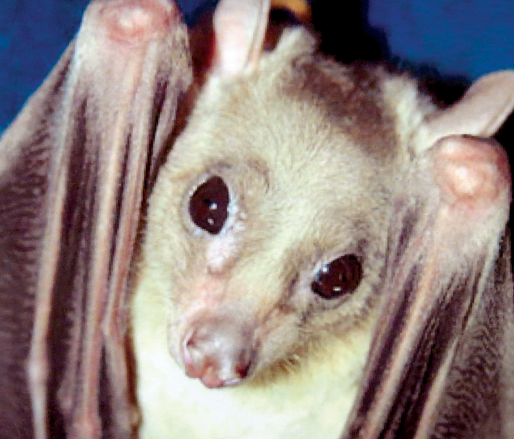
The New Mexico brown bat is one species that could be threatened by a deadly fungus called Pd, if it reaches the southwest.