

BY COLLEEN KEANE
SPECIAL TO THE TIMES
ALBUQUERQUE — In a historic move, all 23 New Mexico tribes, nations and pueblos have signed off on a proposed state bill backing the Standing Rock Sioux Tribe’s steadfast resistance to the last leg of the Dakota Access oil pipeline.
Senate Joint Memorial 20 is sponsored by senators John Pinto, Diné (D-McKinley/San Juan) and Benny Shendo, Jr., Jemez Pueblo, (D-Bernalillo, McKinley/Rio Arriba/San Juan/Sandoval).
Endorsements came from: Navajo Nation, Pueblos of Acoma, Cochiti, Isleta, Jemez, Laguna, Nambe, Ohkay Owingeh, Picuris, Pojoaque, San Felipe, San Ildefonso, Sandia, Santa Ana, Santa Clara, Santo Domingo, Taos, Tesuque, Zia, Zuni, Jicarilla Apache Nation, Mescalero Apache Tribe, Fort Sill Apache Tribe, and Ysleta del Sur.
The 1,172-mile pipeline is designed to transport around a half million barrels of crude oil a day from North Dakota to an oil vat in Illinois, according to an online source.
Looking at a North Dakota map, the pipeline path travels closely above Standing Rock Sioux lands and water resources Lake Oahe, the Cannonball River and the Missouri River.
Standing Rock’s concerns about potential leaks, breaks, and accidents garnered international support with thousands protesting over the past year near the construction site at Camp Oceti Sakowin.
SJM20 states that the tribal governments stand in solidarity with Standing Rock, and that the U.S. government violated treaty agreements by failing to participate in meaningful consultation.
“Mother Earth can’t speak for itself. We have to speak for her,” said co-sponsor Shendo.
Added Navajo Nation President Russell Begaye in an email to the Times, “There are times in our history as indigenous people when we have to stand together to protect our natural resources, especially our water. This is not only about the water that the Standing Rock Sioux Nation uses. It’s also about the water utilized by millions of people all the way to the Gulf of Mexico. Water is something that we as indigenous people will always stand up to protect. We also know that when the time comes to protect our water from devastating contamination, we will not stand alone.”
Chimed in Jicarilla Apache Nation President Wainwright Velarde in a quote provided by Pinto’s office, “Contaminating the rivers is like cutting off your lifeline. We support our brothers and sisters in their peaceful demonstration to find alternatives to this measure that protects the sovereignty of the Tribe for their sacred lands, water, and people.”
As one of his first actions in office, U.S. President Donald Trump expedited a federal access permit that allowed the oil pipeline construction to start back up, despite tribal and international protests.
A legal source said that with the construction revival, oil could be flowing in the next few weeks.
Former President Barack Obama halted construction last year pending additional environmental impact studies for the areas of concern to Standing Rock.
SJM20 calls upon Trump to stop construction and engage in meaningful government-to-government relations based on treaty rights and responsibilities.
Senate approval
On March 3, SJM20 passed the Senate with a vote of 29 to 8.
When his colleagues voted in favor, Pinto told them it nearly brought tears to his eyes.
“I really appreciate you from the bottom of my heart,” stated Pinto.
During debate on the senate floor, Sen. Jeff Steinborn (D-Dona Ana) stood in support.
“The voice of people, especially those from sovereign nations, is very important. We are supporting their critical resources of water,” he stated, adding that the federal government could look for alternative routes.
“We can have commerce and protect cultural sites and important natural resources,” he commented.
Sen. Cisco McSorley, (D-Bernalillo) also expressed enthusiastic support.
“It’s important that New Mexico stand up for people whose voices have not been heard,” he noted.
McSorley advised the senate that the Dakota Access Pipeline was originally routed through non-Indian towns and cities, but citizens there objected, which resulted in the contested pipeline route upstream of Standing Rock.
“I hope this will help Standing Rock,” stated co-sponsor Pinto after SJM20 passed the senate.
Shendo said the united tribal government backing benefits Standing Rock and tribes across the country. “Standing Rock is a culmination of Indian people coming together saying enough is enough. We are going to stand up for our rights, for our land, and for our people. This is not the late 1800s anymore. This is the 21st century,” he said after the bill passed in the senate.
Committee approval
Prior to getting the senate’s green light, SJM20 passed the Senate Indian and Cultural Affairs committee 3-2 on Feb. 23.
During the hearing, there were only a few people in attendance, but their voices were strong, determined, and represented many more.
“We stand behind sovereignty for Standing Rock to protect its land and water,” said Dan Lorimier, a Sierra Club spokesperson.
The Sierra Club has hundreds of thousands of members across the world, according to a representative.
“This movement has not lost momentum. I’m very thankful for what’s happening here today, because I think it’s important to remind everyone this movement has just begun,” added a young woman, one of many youth who have stepped out locally and nationally to protest the Dakota access pipeline.
“I thank you for pulling this memorial together. All of my relatives from Cochiti are gone. New Mexico can really send a message to consider those communities, so they are not sacrificed too,” testified a Cochiti Pueblo tribal member who shared with committee members that his community has suffered cancer clusters after local water sources were polluted by upstream uranium mining.
Previous to passing the Indian and Cultural Affairs committee, SJM20 passed the Rules Committee.
Last hurdle
This past Saturday, the joint memorial was heard on the house floor.
Approved there, it was sent on to the House State Government, Indian and Veteran Affairs committee.
Rep. Georgene Louis, Acoma Pueblo, (D-Bernalillo) chairs the committee.
A staff person in her office said that it may be heard early next week.
The legislative session ends March 18.
Those opposing SJM20 argued that since tribes are sovereign they didn’t need a state bill. Others expressed concern that if the oil isn’t shipped via a pipeline, it will be transported on trucks, which they say is less safe.
Energy Transfer Partners, a key DAPL developer, claims the pipeline is safe, efficient, and environmentally sound.
Tomorrow, Standing Rock and other Native Nations are holding a rally and prayer day in Washington, D.C., according to the tribe’s website.
Information: www.standingrock.org, sierraclub.org daplpipelinefacts.com
COURTESY | OPVP
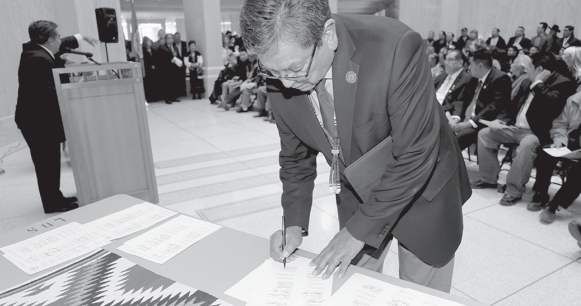
Navajo Nation President Russell Begaye adds his signature on a letter to U.S. President Donald Trump and New Mexico delegates expressing united New Mexico tribal support for the Standing Rock Sioux Tribe.
SUBMITTED | CHARMAINE JACKSON
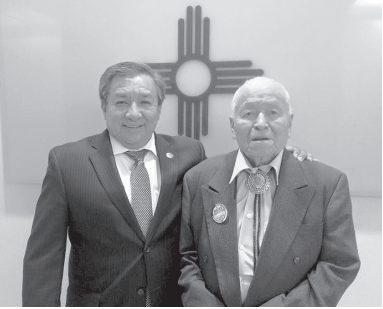
SJM20 sponsors Senator Benny Shendo, Jr. (left) and Senator John Pinto pose for a photo.v