
BY COLLEEN KEANE
SPECIAL TO THE TIMES
ALBUQUERQUE — When Jennifer Wheeler was a little girl growing up in Many Farms, Arizona, she spoke only Navajo at home.
When she stepped on the school bus, she focused on speaking English until she was dropped off back home at the end of the school day.
She said she was following her grandmother’s advice.
“Speaking the Navajo language she told me in her most gentle way, ‘When you step foot on that bus, you can switch your thought and speech to English. You can speak English all you want at school. And that’s great. I encourage that. But, when you come home and get off that bus, switch back to Navajo,”’ said Wheeler.
Growing up, Wheeler often sat next to her grandmother, Elizabeth Wauneka, as she read Bible verses in Navajo. At the time, it was the only book avail- able in the Diné language.
Wheeler said that her grandmother learned how to read and write her native language in the 1900s while attending Good Shepherd Mission.
“By the time we came along as grandchildren, she read Navajo proficiently. I was the only one interested. So, she started teaching me how to spell words and identify high-tone, nasal, and glottal sounds,” recalled Wheeler.
With that foundation, Wheeler said her grandmother encouraged her even more, saying, “‘You already speak Navajo, learn English the best that you can and utilize both of them, value both of them. In the future those two languages will sustain you.’
“As a child in mid-school in the middle of the reservation, I had no clue what she meant by that,” said Wheeler.
But, as time went by, her grandmother’s wisdom served her well.
“My ability to be literate in the Navajo language allowed me to be a better speaker, writer, and reader of the English language,” said Wheeler.
Wheeler is the Navajo language and culture education specialist for the Navajo District of the Bureau of Indian Education. She holds a doctorate in English.
Wheeler shared her story to stress to parents that teaching the Navajo language at home is as important today as it was when she was growing up.
“I really wish that my people would understand that learning Navajo will not negatively impact their children’s academic success in the Western world,” she said.
As Wheeler shared her memories, numerous Diné language teachers listened closely at the first large-scale Diné Language Symposium hosted by the BIE’s Navajo District.
The gathering was held last Friday at the Embassy Suites.
More than 150 teachers, staff and administrators from BIE, public and tribally-controlled schools attended, along with partners from tribal and state universities.
“Look at all these teachers!” said Wheeler referring to their bi-literacy and professional status.
“We prove that growing up knowing our language gives many opportunities,” she said.
In addition to organizing the symposium, Wheeler implemented the first Diné language assessment at all 31 BIE schools in the Navajo District last fall.
“The proficiency in general among the Navajo District is very low,” said Wheeler.
Preliminary results reveal that about 95 percent of the students lack fluency in the Navajo language.
But, Wheeler added, while the statistics are alarming, the data can help mobilize language revitalization.
“We can use the current data to really motivate us to continue teaching Navajo,” she said.
Barsine Barney Benally, a Diné College professor, said that historical data helps students in the Diné Teacher Education program engage in teaching and learning.
In her session, she said that students are required to create a color-coded historical time- line of language loss in their families.
“They have to go back and determine why their family members lost Navajo,” Barney told the group of Diné language teachers in her session.
The different colors in a sample timeline represent various levels of fluency: red, no fluency; green, fluency; pink, relearning; purple, trilingual, to name some.
Benally said the activity helps students engage in learning and teaching the Diné language because it provides an understanding of language loss that she said was often caused by boarding school placements, isolation and trauma.
The symposium explored numerous other classroom strategies: learning the Diné language through song; how to engage families in school culture, curriculum development, immersion techniques; acquisition of rich verb forms, mathematical model drawing; and major movies dubbed in the Diné language made possible through support from the Navajo Nation Museum.
But, Wheeler said, the effort to revitalize the Diné language needs to expand past the class- rooms to halls, playgrounds, neighborhoods, bus rides and homes, as well as to academic standards, policies and laws.
“We really need to roll up our sleeves and save our language,” she said.
The Department of Diné Education, the Bureau of Indian Education, several tribal colleges, school districts, community schools, and the Navajo Nation Museum provided support for the symposium.
“This wouldn’t have happened without them,” said Wheeler.
Wheeler said that wide collaboration is needed in order for change to take place.
She said that state laws require teachers to spend most of their day instructing the common core – math, English, and science – which leaves little time for Navajo language teaching and learning.
“That’s a challenge. Students need Navajo language classes every day. Every Navajo child deserves the right to learn their language,” said Wheeler.
Offering more collaborative experiences, Diné College is hosting the 2017 Diné Language and Culture Revitalization Summit May 22-24, 2017, in Tsaile, Arizona.
For more information, con- tact the BIE Navajo District at 928-871-5932 or visit navajolan- guagesummit.com
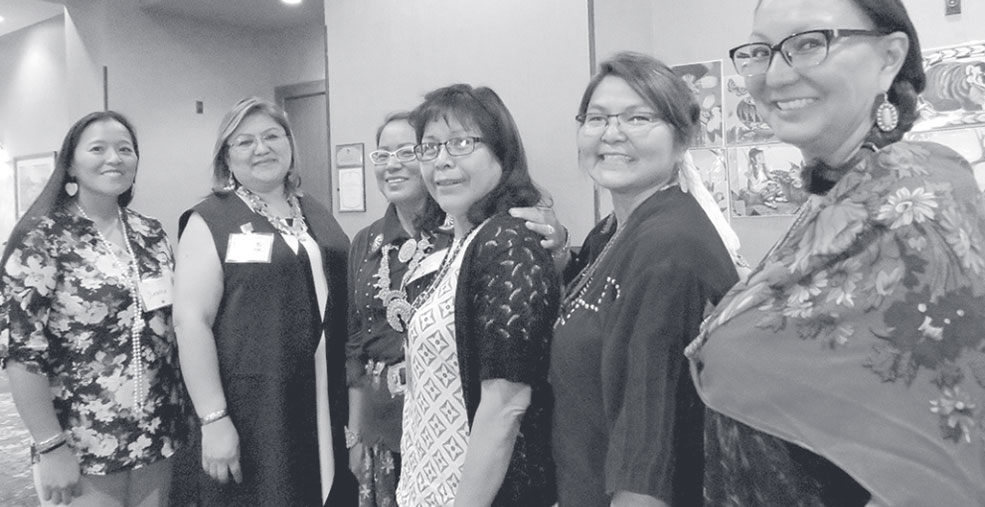
From left to right, Diné language educators Dawna Charley, Indian Wells Elementary School; Barsine Barney Benally, Diné College; Kimberly Becen- ti, Navajo Prep; Maggie Benally, DODE; Jennifer Wheeler, BIE; and Edie Morris, Wingate Elementary, stand in unity during the first BIE Diné language symposium.