
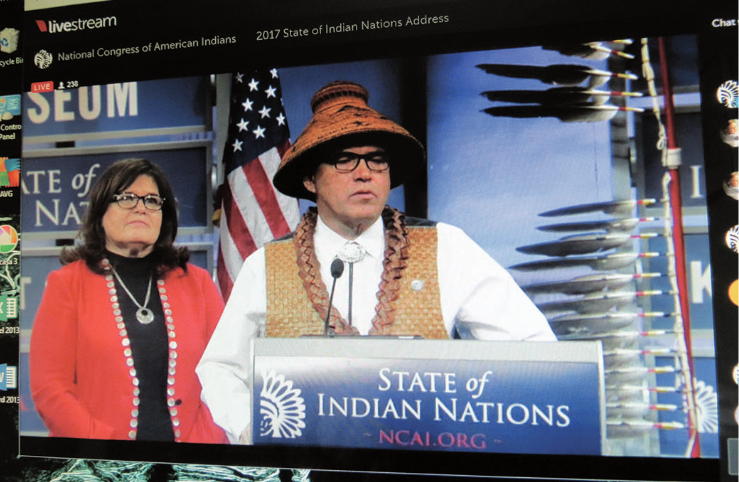
NCAI President Brian Cladoosby appears in a live online stream presenting the 2017 state of the union address highlighting Native American contributions to the United States.
BY COLLEEN KEANE
SPECIAL TO THE TIMES
ALBUQUERQUE — There’s more than one national state of the union address.
There’s the one that is delivered by the American President, then there’s the one that is delivered by the president of the National Congress of American Indians.
Founded in 1944, NCAI is the oldest, largest, and most representative American Indian and Alaska Native organization in the country, according to its website.
Newly elected U.S. President Donald Trump made his nationally televised address on Feb. 28.
The theme: America first. But not one word addressed contributions of the indigenous people who were here first.
The only reference he made about the 560 sovereign tribal governments located within the boundaries of the U.S. was his executive order that lifted the construction ban on the Dakota Access pipeline despite yearlong protests from the Standing Rock Sioux Tribe and its allies from across the world.
A week before Trump’s address, NCAI President Brian Cladoosby, Swinomish Indian Tribe, filled in the tribal narrative with detail and precision.
Streamed live from Washington, D.C. on Feb. 13, Cladoosby put Native America first, while extending a wide welcome to the new administration to partner with sovereign Tribes for everyone’s benefit.
Cladoosby began his address by saying the Native story has historically been left out of the country’s narrative.
But he told viewers that that shouldn’t deter them from moving forward
He recalled a moment in the past when he met with Billy Graham, the well-known spiritual advisor who appeared in nationally televised rallies.
Graham told him, “Never get tired of telling your story.”
As part of the Native story, Cladoosby reminded the audience that the Northwest Ordinance set forth the principles of a trust relationship between Tribes and the Federal government.
“The utmost good faith shall always be observed towards the Indians; their land and property shall never be taken from them without their consent; and, in their property, rights, and liberty, they shall never be invaded or disturbed,” the ordinance reads.
Cladoosby noted that that didn’t happen.
But, he continued, things are different today.
Tribes are prepared to protect their lands and waters.
“So, this is what we ask of the new Congress and the new Administration: Make good on the promise of our trust relationship. Abide by the treaties!” called out Cladoosby to the people in the room and over the Internet.
In so doing, partnerships will benefit tribal and non-tribal communities, he predicted.
“Indian Country stands ready to partner with anyone and everyone who will work with us to help build a stronger America.”
During his address, Cladoosby highlighted tribal nation contributions to the United States since 1789 when the U.S. constitution was adopted.
“It was modeled after the great Iroquois Confederacy. It recognized our treaties as the supreme law of the land,” stated Cladoosby.
In more recent times:
• In Idaho, the Coeur d’Alene Tribe in partnership with the city of Plummer built the Benewah Medical Center serving the surrounding area with health care services.
• In Mississippi, the Mississippi Band of Choctaw Indians established thousands of farms supporting 72,000 operators who have added billions of dollars to the national economy.
• In Nevada, a solar project designed and constructed by the Moapa Band of Paiute of Nevada began powering more than 100,000 homes in Los Angeles last year.
• In Colorado, the Southern Ute Indian Tribe controls the distribution of roughly 1 percent of America’s natural gas supply.
• In the Dakotas, the Sioux Nation began construction on one of the largest wind power developments in the entire nation.
• The Shakopee Mdewakanton Sioux employs more than 4,000 tribal and non-tribal members through its retail, gaming, and other businesses.
“Investing in Indian Country has proven, time and time again, to produce high returns,” stated Cladoosby.
While all of these initiatives and more have added to the national economy, Cladoosby noted the greatest contributions came from Native American and Alaska Native men and women who volunteer their services in the U.S. military.
“We stood with you at every critical moment in American history,” he stated, identifying every era from the Revolutionary War, to the World Wars, Vietnam War, and War on Terror.
“A greater percentage of Native people have served and died in the military than any other group of Americans,” he stressed.
In addition to highlighting contributions, Cladoosby also addressed the struggles, keying in on the Standing Rock Sioux Tribe’s resistance to the Dakota Access Pipeline.
Standing Rock maintains that the oil pipeline constructed upstream from their lands will endanger sacred sites and water sources.
“This has been one issue that has galvanized the world. I watched Michael Jackson’s daughter on the Grammys stand up and say, ‘NO DAPL!”’
Responding to the Chairman of the Ute Tribe’s concern that tribal lands and resources are once again threatened, Cladoosby advised, “Every single tribe in here has lost land. Many are still fighting to be recognized. So, Chairman, we definitively need to educate new congress- men and old ones and tell them our stories.”
He said the stories will tell about the continued resilience of tribal communities and a new era of progress.
“We are, in the words of Chief Seattle, “like the stars that never change,” he remarked.
Information: NCAI.org.