
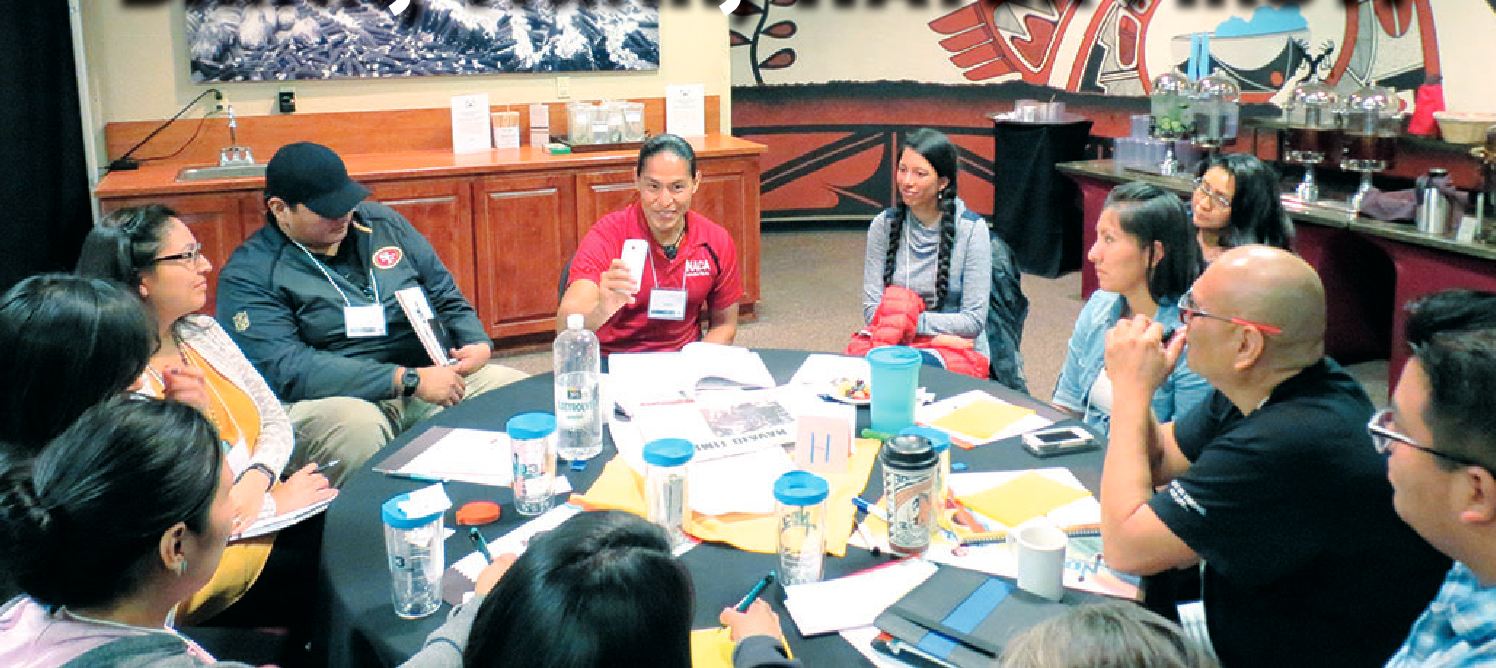
Holding up his cell phone, Leroy Silva, Laguna, suggests using social media as a way to get the word out that sugary drinks are out and water is the way to go at one of last week’s healthy beverage summits.
BY COLLEEN KEANE
SPECIAL TO THE TIMES
ALBUQUERQUE — There’s a choice – sugary drinks in ugly containers that put you at risk for chronic diseases, or clear, refreshing water that makes you healthier in a cool cup of your choice.
That’s the challenge healthy drinking advocates are sending out to tribal communities in Arizona and New Mexico.
Last week, the Notah Begay III Foundation brought together more than 125 Native American educators, youth advocates and health workers to the first of three annual healthy beverage summits.
The daylong retreat, featuring water as the drink of choice, was held at the Indian Pueblo Cultural Center on Feb. 8.
On and around the large meeting room there wasn’t one Coke, Sprite, Pepsi, or gaudy, plastic cup in sight.
But plenty of fine, crystal clear water bottles and cups of natural tea could be seen everywhere.
The participants included staff from tribal organizations that received NB3 Water First Learning Community Cohort grants.
The recipients are: Community Outreach and Patient Empowerment, project out of Gallup, Five Sandoval Indian Pueblos, Inc., Jemez Pueblo, the Mescalero Apache Tribe, Ramah Navajo School Board, Santo Domingo Pueblo, STAR School out of Flagstaff, Arizona, Tamaya Wellness Center, Santa Ana Pueblo, and the Zuni Youth Enrichment Project.
Funding for the projects, around $30,000 a year for three years, came from the W.K. Kellogg Foundation.
The goal is to encourage Native children to drink less sugary drinks and more water, while promoting breastfeeding.
“We’re having an epidemic of diabetes and obesity. The main factor driving the epidemic is too much sugar in the diet,” said keynote speaker Dr. Jim Kreiger, executive director of Healthy Food America.
He added that most sugar intake comes from sodas, energy drinks, and sweetened coffees.
“Our children are consuming a huge amount of sugar through beverages,” said Justin Huenemann, Diné, NB3’s Native Strong executive director.
He said that nationally, people consume an average of 70 pounds of sugar a year.
The recommended amount is 6 teaspoons a day, according to the World Health Organization.
One 12-ounce can of soda has about 9 teaspoons of sugar. In addition to the risk of heart disease, diabetes, and obesity, there’s tooth decay to think about when consuming sugary drinks, warned Huenemann.
The hosts, NB3’s Native Strong staff, brought the group together to share ideas on how to reach tribal members with the message of “water first” and develop outreach projects customized to their communities.
Dozens of ideas posted on the wall included: bring back the tradition of breastfeeding; limit sales of sodas at stores; use grandma’s teachings; and educate leadership, to name a few.
“We’re fighting hard to protect water,” noted participant Leroy Silva, referring to protests like the ongoing fight to stop the North Dakota oil access pipeline construction.
“Let’s protect it and let’s also drink it!” he stressed.
Silva is an educator at the Native American Community Academy, NACA.
In a break out session, he held up his cell phone.
“Everyone has a cell phone and everyone has access to social media. This is how we get the message out,” suggested Silva.
So, the group suggested to watch out for memes, videos, Facebook alerts, links, tweets, and possibly hashtags such as, #NB3, #waterfi rst, and #watertime.
At another break out table, health advocate Gloria Begay, Diné, suggested putting the word out through Native radio.
There’s several tribal radio stations in New Mexico and Arizona, including KTNN broadcasting out of Window Rock, Arizona, Alamo’s KABR-FM, Ramah’s KTDB-FM and Zuni’s KSHI Radio.
Begay said that the Food Sovereignty Alliance, a grassroots program helping communities rebuild local food sources, is in the process of creating Native American video games featuring traditional teachings.
Special guest speaker Navajo Nation Vice President Jonathan Nez, who flew in from Window Rock, to present at the summit, told the group that going back to traditional ways is the key to healthy choices.
Nez advised tribal members to recall the wisdom of the late very respected Diné storyteller, James Peshlakai, who’s remembered for promoting traditional ways as weapons against modern day monsters, like diabetes, heart disease, obesity.
Sugar, as sweet as it is, sticks out as the main culprit for each.
It’s not at all traditional, participants pointed out.
Words like Coke and Pepsi, can’t even be translated into tribal languages noted Trisha Moquino, director of the Keres Children’s Learning Center.
“Today at this summit, we need to embrace the old ways of Navajo teachings. We need to bring some of that knowledge and those teachings into the 21st century. It will greatly benefit the health and wellness of all indigenous people,” Nez told the audience.
But, for some families, cut- ting out sugary drinks may not be that easy because of the lack of access to fresh water.
“It’s the lack of availability. The school where I go, students don’t trust the water,” said Mikki Metteba Diné, a junior at Window Rock High School.
Jaden Redhair, also a junior there, said tribal members need to pursue specialized education to help bring clean water sources into communities.
“One way is get more students to go into the field of hydrology so that they can help improve the water systems,” Redhair advised.
It’s especially needed in communities contaminated by uranium mining.
In the Flagstaff area, in Arizona, the Star School is working with local governments to establish a fi ltering system, since the water there is filled with minerals.
“It doesn’t taste good,” said one participant.
Nez encouraged the group to take what they learned from the summit, like the recent pas- sage of the Navajo Nation’s junk food tax, and share it with their communities.
“It has empowered you, so you can reach another individual out there to continue this movement of healthy living and remind ourselves that we are resilient. From there, you will have the power to change your family, your community and your Nation for good,” he stated.
For more information: nb3foundation.org