
BY COLLEEN KEANE
SPECIAL TO THE NAVAJO TIMES
ANTA FE, N.M. — Navajo Na- tion President Russell Begaye smiled when Rep. Brian Egolf (D), New Mexico Speaker of the House, greeted him just minutes before a joint house session was about to begin.
Egolf was wearing an exquisite, double-strand turquoise necklace similar to the multistring of corral and turquoise beads he put on that morning.
Paul Torres, Chairman of the All Pueblo Council of Governors, also expressed appreciation to Egolf for demonstrating respect for Native American leadership and culture on Indian Day, celebrated at the state capitol last Friday.
In Torres’s address on the house floor, he recalled how past relationships weren’t always so pleasant.
“There’s plenty of history between the state and New Mexico tribes. There’s been seeds of doubt, layers of misunderstanding and misinformation, mixed with mistrust,” he mentioned.
His audience – community members and leaders from the Navajo Nation, Mescalero Apache Tribe, the Jicarilla Apache Tribe, the 19 New Mexico pueblos, Ysleta del Sur Pueblo in Texas, the president of the Fort Sill Apache Tribe and a council delegate from the Standing Rock Sioux Tribe, who sat side by side with state legislators and representatives.
But, Torres stressed, “I want to propose a new beginning to the way tribes and the state legislature have treated one another in the past. I would like to have us revive and resurrect those time tested, traditional, and revered values of respect, trust, civility and common courtesy. House Speaker, Brian Egolf, has certainly started us down that path. Thank you, Mr. Speaker!”
The speaker, one of the most powerful positions in the round house, invited tribal leaders to present in the joint session so they could inform state law- makers of issues and concerns in their home communities. “It’s a fitting moment to reiterate that this house of representatives understands and respects the strong government to government relationships that exists between this house, this legislature, the state of New Mexico and all the tribal governments,” Egolf told tribal leadership.
The theme of this year’s Indi- an Day was “Partnering for a Better Tomorrow.”
In his talk, Torres stressed that collaboration is especially needed in a year that’s been hit hard by oil and gas income losses, along with responding to the chaotic fallout from the recent presidential election.
“We are coming off one of the most divisive and unprecedented presidential campaigns, I have ever witnessed,” he noted.
Torres and Begaye were two of several tribal leaders who spoke during the joint house session.
Both brought attention to tribal contributions to the state of New Mexico and how state funding can benefit both sides of state-tribal jurisdictional lines.
Torres identified employment opportunities, workforce and revenue streams that benefit the state.
He estimated that tribes and tribal enterprises employ 18,000 workers, around 75 percent of them non-Indians.
With non-members working on tribal lands, more often than not, they live in cities where they pay sales taxes on automobiles, gas, food, clothing, equipment and gross receipt taxes for business services.
Likewise, tribal members living on and off native lands pay the same taxes, all of which puts millions of dollars into the state’s coffers each year.
When he took the podium, Begaye looked over the floor and gallery above. He noticed that many in the audience were members of the Navajo Nation, along with an impressive list of New Mexico Native American legislators, past and present.
They included, Senator John Pinto, Dine’ (D-District 3); Senator Benny Shendo Jr., Jemez (D-District 22); Sharon Clahchischilliage, Dine’; (R-Distict 4); Rep. Georgene Louis, Acoma (D-26); Rep. D. Wanda Johnson, Dine’ (D-District 5); and former New Mexico Senator now Navajo Nation Council Delegate Leonard Tsosie, Littlewater/ Pueblo Pintado/Torreon/ Whitehorse Lake/Baca/Brewitt/Casamero Lake/Ojo Encino/ Counselor, to name some.
Giving the audience a glimpse of his workday in Window Rock, Begaye noted that he’s often signing contracts for services and products.
“More than 80 percent of contracts made with the Navajo Nation go to off-reservation companies,” he stated noting that he envisions more tribal business development in the near future.
He added that the Navajo Nation pays around $7 to $8 mil- lion a year to the state in gaming income and that the Nation is spending millions of dollars to pave roads and lay water and electric lines for hotel construction projects.
To reinforce and build on these investments, Begaye asked New Mexico lawmakers to keep the Tribal Infrastructure Fund, TIF, as one of their top priorities.
TIF funds projects that provide access to water, electricity and gas lines to community members and infrastructure, like roads and building construction for business development.
Looking into the future, Begaye sees the Navajo Nation growing a robust national and international market place, with New Mexico as a key partner.
Giving organic food production as an example, Begaye enthusiastically proposed that with support from state programs, like TIF, along with small business loans and incentives, “We can manufacture our own products. We can produce it right here in New Mexico.”
Torres appealed to the state lawmakers to stop and think before making cuts to education programs that would impact Native American students who could fill jobs back home and reduce state unemployment rates.
That morning, sitting next to each other at tables lined up on either side of the rotunda, state and tribal program staff handed out information about health, education, employment, youth activities, and much more.
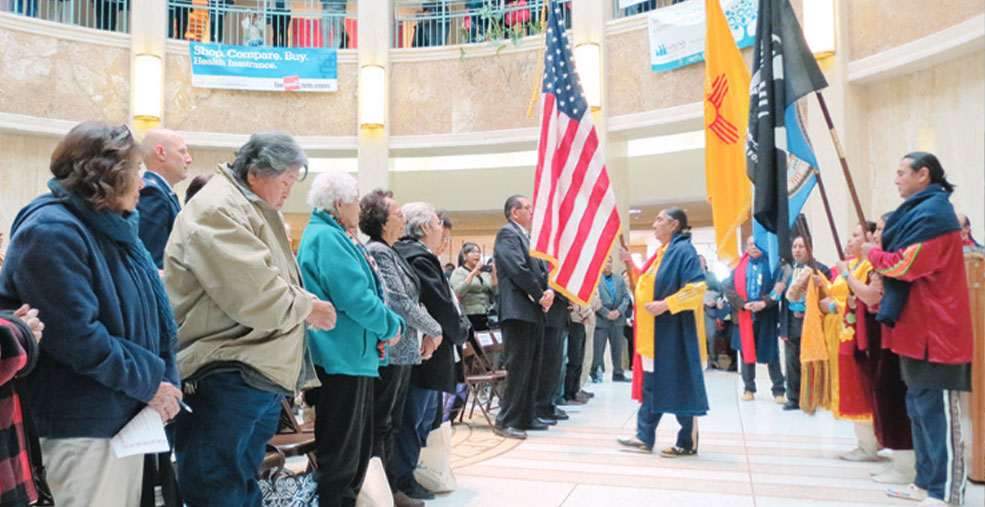
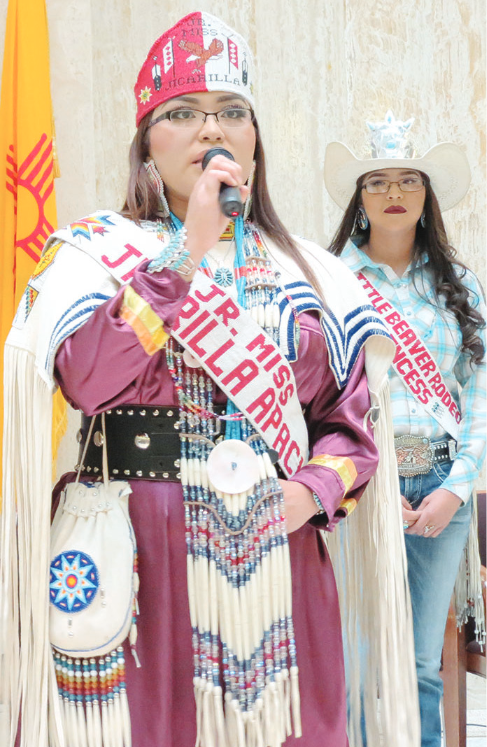
In the rotunda, the Taos Pueblo color guard honored veterans, the Santa Fe Indian School drummers performed, Native American royalty spoke out on behalf of students and Indian Affairs Cabinet Secretary Kelly Zunie (Zuni Pueblo) introduced several of the state’s chief executives.
“We have a wide range of services and tribal liaisons who connect people with services. Partnerships make a difference,” stated Lynn Gallagher, Cabinet Secretary, Dept. of Health.
“We need to listen to our communities. Our number one asset in our state is our people,” stressed Jay Mitchell, Cabinet Secretary, Dept. of Homeland Security and Emergency Management.
“It was a good day for me, today,” said Norman Henry, vice-president for the Tse’łigai (White Rock) chapter as he left the rotunda.
Henry said that he learned about state services and the layout of the state capitol.
“I visited the Governor’s office, committee rooms, the house and senate floors,” he said.
Along the way he and chapter manager Linda Phillips talked to legislative analysts and leaders.
“It’s really good to put names and faces together. It makes it easier to reach out to state programs and find out about their services,” said Phillips.
Pleased with seeing so many chapter officials and tribal members at the round house on Indian Day, Begaye noted, “It’s good to see our people engaged, talking and connecting.”
It was a good day for Torres, too.
“I truly believe something better awaits us, if we simply have the courage to reach out to one another and stand together,” he stated.
The session began on Jan. 17 and ends on March 18.
For more information visit nmleg.gov and iad.state.nm.us
SPECIAL TO THE TIMES | COLLEEN KEANE
Tribal leaders and community members, along with state officials and staff, stand to honor the Taos Pueblo Veterans Color Guard as they advance through the rotunda on Indian Day last Friday.
SPECIAL TO THE TIMES | COLLEEN KEANE
Kelly Zunie, Cabinet Secretary/Indian Affairs Dept., looks on proudly as Miss Jicarilla Apache Clarisa Anderson (front) and Little Beaver Rodeo Princess Ashley Talabaza (left back) present to hundreds of visitors during Indian Day at the round house last Friday.