


Actress and activist, Lynnette Haozous, San Carlos Apache/Diné, listens as Leandro Cruz, Santa Ana Pueblo, sings a song honoring water rights and resources.
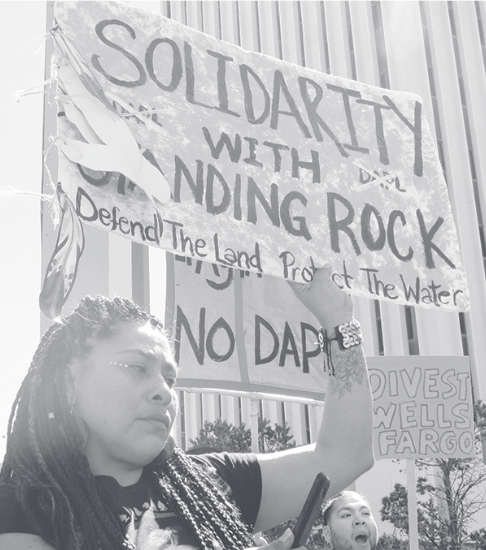
Water rights advocates hold up signs supporting Standing Rock by not investing in Wells Fargo during a rally last week for Standing Rock.
NO-DAPL protesters, ‘Divest!’
BY COLLEEN KEANE
SPECIAL TO THE TIMES
ALBUQUERQUE — Leandro Cruz from the Santa Ana Pueblo did not know what his purpose would be when he traveled to Camp Oceti Sakowin, the pipeline protest camp in North Dakota last October.
But, once there, his direction was clear.
“Singing is what I love to do, so that’s what I did out there,” he said mentioning he stayed about six weeks.
During the past year, thousands of people made Camp Oceti Sakowin their home expressing support for Standing Rock Sioux Tribe’s resolute stance that the last leg of the pipeline path endangers their people’s health, resources, and way of life.
Despite the protests that garnered international support, soon after he became president, Donald Trump signed an expedited order paving the way for pipeline construction.
According to some reports, the pipeline could be complete and oil flowing any day now. But, the fight isn’t over against the current route that runs above and under the Tribe’s main water sources, the Missouri River and Lake Oahe. It just keeps moving to other grounds.
And last Friday morning, Cruz raised his voice once again in song – this time in front of the Wells Fargo Bank on 3rd and Lomas in Albuquer- que. With the financial building, a landmark in the city, looming overhead, Cruz and about 100 tribal and non-tribal members sang, chanted, and prayed for Standing Rock and for envi- ronmental justice in their own communities.
“We need to stand against these big corporations. They don’t understand the ancestors are looking down on them,” called out water advocate Marlo Grey over a loud speaker.
His voice carried to the street where protesters, many in their 20’s and 30’s, chanted, “Down with the pipeline! Up with the people!” Protestors held up signs that read, “Water is Sacred,” “Sol- idarity with Standing Rock,” and “Switch to a Credit Union.”
they sent out the message to drivers and surrounding businesses to divest from Wells Fargo because it is one of the many banks financially backing a pipeline development company, Energy Transfer Partners.
“I want everyone to know this isn’t just a native fight. It’s an all-human fight. It’s for our future. It is about basic hu- man rights,” called out artist, activist Lynnette Haozous, San Carlos Apache/Diné. “Let the banks know that they are investing in corporate greed!” shouted Haozous. “Money rules everything.
That’s why we want to get people to divest,” explained Peaches Blackbird, Zia/Oglala Sioux, co-organizer with Reyes Devore, Pueblo of Jemez. “It’s not OK that they’re at- tacking people’s rights to clean water,” stressed Devore. Like many their age, Black- bird and Devore identify as the 7th generation.
According to historical references, Lakota spiritual leader Black Elk, prophesied that seven generations into the future, tribal members would rise up in united resistance to environmental injustices. “We were at Standing Rock. We came back home to fight for our people,” said Blackbird, adding that Trump’s executive action expediting the final stretch of the pipeline intensified their efforts.
“My bloodline is rooted in this. Let us continue to rise. We are passing on the legacies that our grandmas and grandpas passed on to us,” she stressed. When she returned from Camp Oceti Sakowin, Blackbird established Power through Peace, a direct action network that plans and promotes events like Friday’s protest. Soon after Devore returned home, she set up Pueblo Ac- tion Alliance, another social action organization focused on
‘Money rules
everything. That’s why
we want to get people to
divest,.’
Peaches Blackbird
co-organizer
environmental justice in tribal communities, and teamed up with Blackbird to spread the word.
On the new protest grounds with other 7th generation activists, Devore underscored the message of the day – banks need to step up and become socially responsible.
“We want people and businesses to continue to defund from Wells Fargo because they are loaning money to Energy Transfer Partners,” she said.
The 1,170-mile pipeline from North Dakota to Illinois reportedly has a construction price tag of $3.8 billion.
According to a statement from Wells Fargo to the Navajo Times on Monday, Wells Fargo is one of 17 banks providing loans to Energy Transfer Partners.
The Wells Fargo loan is around 5 percent of the cost said Wells Fargo spokesperson Michael English, who represents New Mexico and parts of Texas.
English said the protest on Friday, and three previous ones, have captured the attention of bank officials.
In response to the protest, the company statement continues, “As a company committed to environmental sustainability and human rights, we respect all the differing opinions being expressed on this project. We are contractually bound to fulfill our obligations under the credit agreement as long as our customer continues to meet all of its terms and conditions. That said, as we learned about the Standing Rock Sioux Tribe and their supporters’ opposition to the project, we met with the tribe and other tribal advocacy organizations to learn about their concerns. We also met with Energy Transfer Partners to share the tribe’s concerns and to emphasize the need for appropriate engagement with the tribe,” the statement reads.
Recently, the city of Seattle withdrew millions of dollars from Wells Fargo in support of the Standing Rock Sioux Tribe. Closer to home, a source said that the city of Flagstaff may take the same stand. Friday’s protest wasn’t just about Standing Rock, though.
“The problem is not just one site. We have to protect our own sacred sites in New Mexico,” stated Grey bringing special attention to Chaco Canyon.
This past January, the Bureau of Land Management held an online auction offering gas and oil leases for 843 acres of public lands surrounding the Chaco Culture National Historical Park. Devoere asked community members to support New Mexico House Memorial 70, introduced by Rep. Derrick Lente, Sandia Pueblo, (D- Rio Arriba/ Sandoval/San Juan).
HM70 calls for a moratorium on BLM’s actions along with tribal consultation. The legislative session ends Saturday.
Like residents living near the Dakota access pipeline, Lente stated, “Most folks are worried about a potential disaster in regards to water and the soil.”
As the sound of drums and Cruz’s voice rose up again in the shadow of the Wells Fargo building, along with the sweet smell of sage burning, the growing number of protesters flowed like water down the street and to all four corners of Lomas and Third.
The NODAPL protesters came together locally Friday, as they did in other towns and cities across the country, to support a national march held in Washington, D.C. organized by the Native Nations Rise Planning Committee, according to the Standing Rock Sioux website.
The marchers of D.C. put forth the following initial demands to the Trump administration:
Meet and work with tribes on environmental issues and projects.
Consult with Tribes and secure consent for actions involving natural resources. Respect indigenous Nations and their right to protect their homelands.
Energy Transfer Partners claims on its website that the pipeline is safe and efficient.
For more information, find Pueblo Action Alliance and Power Through Peace on Face- book or visit standingrock.org and energytransfer.com