
BY FRANCES MADESON
SPECIAL TO THE TIMES
SANTA FE — Due to urgent business in Window Rock, Navajo Nation pres- ident Russell Begaye was unable to address the overflow crowd in the ro- tunda of the Roundhouse in Santa Fe on Uranium Workers Day as scheduled on Feb. 27. Consequently, he missed the celebratory feeling in the air as first the New Mexico Senate and then the House passed memorials urging that the New Mexico Congressional delegation “be requested to continue to support proposed federal legislation to expand and improve compensation under the federal Radiation Exposure Compensation Act.”
With 20 “whereas” clauses, the memorials themselves recite the de- cades-long struggle to extend compensation to uranium workers and those who were downwind of the Trinity test site previously omitted from RECA when it was passed in 1990.
According to Frank Cerno Jr., Secretary of Laguna Pueblo, once the site of the largest open pit uranium mine in the world, uranium is a “human carcinogen and a toxic heavy metal that leads to devastating illnesses such as kidney failure and respiratory illnesses.” His pueblo continues to face the long-term consequences of exposure and has taken substantive measures including testifying on a number of bills, monitoring the companies in the Grants Mineral Belt, and establishing their own Historic Preservation Office.
“We have heeded the call to assist former miners and other workers to get compensated for their exposure to uranium,” Cerno said. “Our pueblo wholeheartedly supports these efforts.”
The devastation on Navajo Nation is also ongoing according to Mark Freeland, Executive Assistant Eastern Agency/State of New Mexico Liaison, who shocked the crowd with his report.
“In Smith Lake, we recently drilled for water,” he explained. “We went down 2,000 feet, and all we found was contaminated water. We’re headed back to the drawing board, and plan to go past 4,000 feet hoping to find clean water for the people there.”
Cal Curley, U.S. Sen. Tom Udall’s field representative, read a statement from the senator reciting three decades of his family’s involvement in seeking justice for those affected.
“My father, Stewart Udall, brought the first court case calling for justice for Navajo miners. The efforts of Navajo activists as well as his work led to passage of RECA. It is historic legislation. But RECA has gaps and does not cover all who should be compensated,” he read from Udall’s statement.
Udall and Sen. Martin Heinrich (both D-N.M.) introduced a RECA reform bill early this year. According to Udall, S. 197 has bipartisan sup- port from Western senators and the sponsors hope to move it forward this session.
“The amendments provide fairness for the victims downwind of the Trinity test site in New Mexico, the former uranium miners and their families in the Four Corners region, and the other victims across the West who were left out of the original law, but who deserve recognition and compensation for their hardships,” Udall’s statement read.
A poignant message was also read from U.S. Rep. Ben Ray Lujan (D-N.M.) who, citing his sense of duty to protect those who were harmed, committed himself to reintroducing legislation in the U.S. House of Representatives. Recalling the detonation by the Untied States of the first nuclear bomb in New Mexico over 70 years ago, he said via his statement: “We can never undo the mistakes of the past.”
The Senate amendments revise certain definitions and dates, change dollar amounts for compensation, address medical benefits, the kinds of workers eligible, and the claims process itself. Most importantly, if enacted, they will expand the eligibility beyond certain counties in Arizona, Utah, and Colorado to all of Arizona, Colorado, Idaho, Montana, Nevada, New Mexico, and Utah, and include uranium workers employed in the mines after 1970. State Rep. Eliseo Lee Alcon (D-Milan), one of the house memorial’s four co-sponsors, expressed a sense of urgency. Alcon, who worked in the uranium mines as a young man, ad- dressed the crowd as one of the “Post- 1971 Uranium Workers.”
“We’re getting old,” he said, “but we are serious.”
State Rep. D. Wonda Johnson (D-Dist. 5), who introduced the memorial in the house (her counterpart in the senate was Sen. John Pinto, D-Dist. 3), recalled the trauma of the Church Rock Uranium Tailings Disaster in which the dam at Church Rock burst sending 1,100 tons of radioactive mill waste and 90 million gallons of contaminated liquid pouring down the Rio Puerco, polluting it as a water source.
“I know firsthand about the damage. I was there. I remember. And I buried my uncle three weeks ago,” Johnson said. “He fought cancer for many years.”
Longtime activist Linda Evers of the Post-71 Uranium Workers Committee told the crowd that passing the memorials and obtaining the support of the New Mexico legislature was the second piece of a two-piece puzzle that Congressional staffers in Washington had told her group was necessary for moving forward. The first was the publication in 2015 of “Looking With- in: A Health Impact Assessment of Uranium Mining” which documented the adverse health impacts of uranium mining in McKinley County. Now that both pieces are in place, her group is swinging into action to help create the political climate nationally in which passage of federal legislation can move forward.
Hers is one of 24 organizations that were represented at the event, which was hosted by The Multicultural Alliance for a Safe Environment. Groups included Bluewater Valley Downstream Alliance, Eastern Navajo Diné Against Uranium Mining, New Mexico Laguna Acoma Coalition for a Safe Environment, Red Water Pond Road Association, Souwest Indigenous Uranium Forum, and Tewa Women United, whose founder Kathy Sanchez offered a centering and grounding invocation in the Tewa language. As the coalition demonstrates, there is a growing political unity between Diné and Puebloan communities who are finding common ground in causes of environmental injustice.
However, it goes without saying that non-Natives have also had to make great sacrifices, were greatly affected, and are actively pursuing justice as well.
“We were the unknowing, unwilling, uncompensated collateral damage of the nuclear weapons program,” said Tina Cordova of Tularosa Downwinders. “We were the first downwinders, and we joined hands and stand shoulder-to-shoulder with the uranium workers. We all suffered the consequences, and we’ve put far too many of our relatives in the ground because of it.”
Every year on the Saturday, closest to July 16, the day in 1945 of the Trinity test (coincidentally, also the day of the Church Rock Uranium Tailings Disaster), people gather in Tularosa to remember the event and its deadly consequences on the area’s residents. In the 2016 commemoration, 3,200 people came together.
“Out of 3,200 people, we lit 800 luminarias in memory of the relatives we have lost to radiation-related diseases,” Cordova said.
Rev. Holly Beaumont of Interfaith Workers Justice explained that the United States did not evacuate the 40,000-60,000 people who inhabited the area surrounding the test site because they wanted to avoid a national security breach.
“But the U.S. government never came back to take responsibility, and we will never accept that injustice,” she said. “Justice delayed is justice denied.”
When the formal program concluded, uranium workers made themselves available to the press.
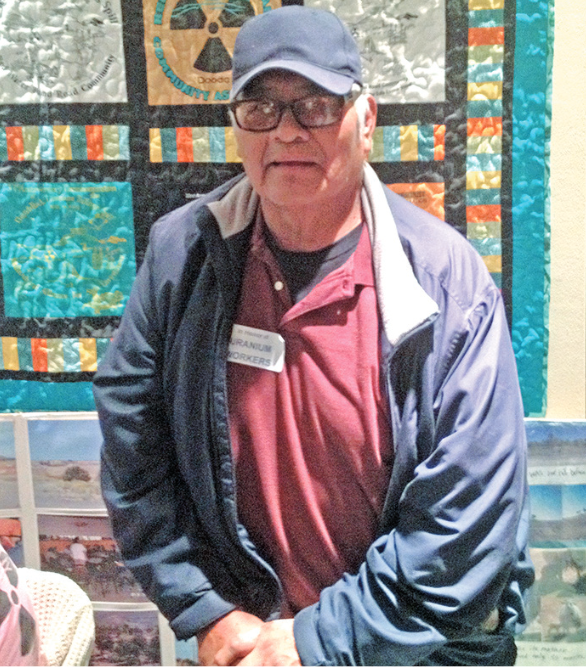
“Grandma and grandpa herded sheep in the sixties,” said Peterson Belle, 61, who is on the executive committee of the Red Water Pond Road Association. “One day some mineral exploration folks came in – they just came in, they didn’t tell anyone, or ask anyone. They started drilling all over the place even in front of our house. A year later, all these mining people from United Nuclear came in, set up camp. They were followed by Kerr-Mc- Gee. We were in the middle of those two mines.
“I worked for them from 1974 to 1982 until they closed the mine. I used to do a lot of supply work from the top to the bottom of the mine, and I was a cager or elevator man picking people up, and did mechanical repair work too.”
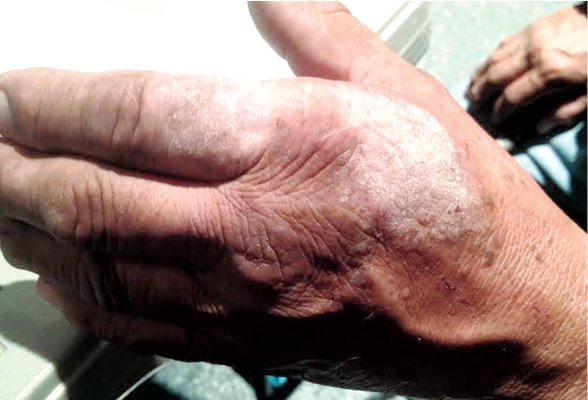
Belle has had a variety of health problems, but one especially persistent and vexing.
“I’ve had this lesion on my hand for 20 years,” he said.
“We used to drink the water, wash our hands and shower in recycled water at the mine,” Eddie Dickens, 64, of Grants, said. Dickens, who followed his father into the mines before going to New Mexico Tech, is the only one in his family not to be diagnosed with cancer.
“So far that is,” he says. “So far.”
SPECIAL TO THE TIMES | FRANCES MADESON
A lesion on Peterson Belle’s hand that he says has not healed in 20 years.
SPECIAL TO THE TIMES | FRANCES MADESON
Former uranium mine worker Peterson Belle tabling for Red Water Pond Road Association on Uranium Workers’ Day at the NM legislature in Santa Fe.