

BY COLLEEN KEANE
SPECIAL TO THE TIMES
ALBUQUERQUE — Where does your water come from?
How much ground water is left after energy companies have come and gone?
What can you do to protect and sustain the water your community needs to survive?
Those are some of the questions Diné environmental activist Nicole Horseherder asked hundreds of attendees at the 2017 Navajo Nation Governance Conference held last week at the Sheraton Airport Hotel here.
The importance of water amidst building evidence of climate change topped off the 4-day gathering at the last gen- eral assembly on March 2.
The theme of the conference: Developing and Ensuring the Integrity of Navajo Gover- nance, in partnership with Ethics & Rules, Elections and Government Development Ad- ministrations.
As part of the last afternoon session, “Before the Flood,” a documentary produced and hosted by award-winning actor Leonardo DiCaprio, was shown.
DiCaprio visits places around the world impacted by dramatic weather changes.
In Alaska, he finds that unsea- sonable conditions are devastat- ing indigenous communities.
“Right now, many of the vil- lages in Alaska are forcefully being moved out because of cli- mate change,” states a scientist featured in the documentary released last September.
According to the film, the globe is warming due to hu- man-caused climate change, most notably fossil fuel burning.
“In the name of short-term fossil fuel profits, we’re leaving behind a polluted planet,” con- cludes DiCaprio.
Closer to home, a first study of its kind, published Feb. 17 by Water Resources Research expresses concern that ongoing drought conditions have endangered the Colorado River, a major water source for many tribal and non-tribal South- western communities.
DiCaprio’s worldwide travel researching global weather changes is aimed at reversing the path the planet is on.
Horseherder called out to the audience to join in on the effort.
“Because our climate is changing, we have to do some- thing if we want to hang on to it. We need to figure out a way to keep it clean. We need to figure out a way to capture it, hold and use it for what we need,” stressed Horseherder during her presentation.
She emphasized that a nation- wide water assessment needs to be conducted, because old studies are out of date.
“Every community region needs to know where their water is; and how they can continue to sustain it for the future,” she stated.
She suggested building and maintaining earthen structures, dams, storages, and diversions while harvesting water.
Horseherder added that community members can help by encouraging Diné youth to pursue engineering and hydrology degrees.
Because they know their communities, “They can say, ‘This is a good place for storage. This would be a good place for irrigation,’ so that development happens in sustainable ways,” she advised.
A member of Chinle Chapter, one of several attendees who spoke out, recommended that salt cedar and Russian olive trees be taken out because they drain water tables.
Johnny Henry Jr., long-time Church Rock Chapter president, who has governed during different U.S. presidential eras, said that there’s an urgent need to support federal environmental programs.
“We have lots of environmental issues. We have to make sure there’s not too much cutting down for us Natives. We depend on federal funds especially for environmental programs,” said Henry.
Among his first actions as President, Donald Trump, who reportedly doesn’t believe in global warming, has indicated that he plans to slash funding for environmental protection programs, and signed executive orders paving the way for the Dakota Access and Keystone XL oil pipelines, despite international protests.
The governance conference also looked at mainstream and traditional philosophies on governance.
Attendees learned about tools for audits, investigations, and planning, along with information about collective bargaining, business ethics, hearings and appeals, legislative process, keeping track of the census and how to improve voter registration outcomes.
A session on traditional governance presented by Ty Edsitty almost entirely in the Diné language was very well received.
Translating Edsitty’s key messages, Jasper Long, from the Office of Navajo Government Development, the agency that hosted the conference, said that Edsitty likened human behavior to the animal world.
Giving an example, Long said, “He talked about raccoon. Raccoon likes to move around a lot and not take care of stuff; just go wherever he wants to go.”
But Edsitty instructed that a leader can’t be like that. He or she has to be patient and sit down and listen.
Like Horseherder, Edsitty said everyone has leadership responsibility.
“Be part of the community to resolve issues,” he counseled.
Information: Visit www.ongd. navajo-nsn.gov. Horseherder is the co-founder of To’ Nizhoni Ani, she is on Facebook.
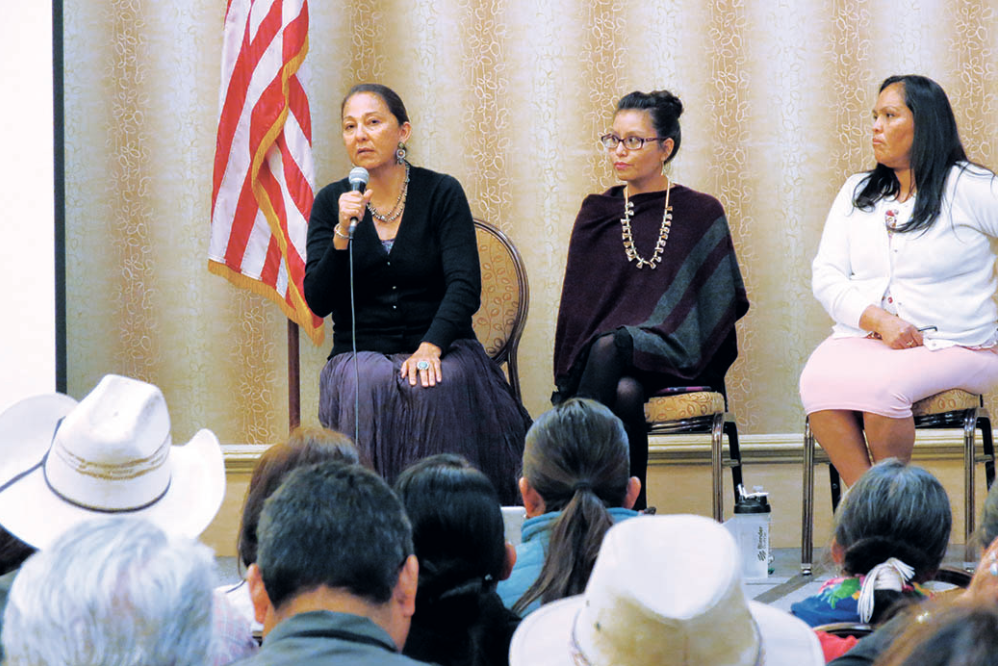
SPECIAL TO THE TIMES | COLLEEN KEANE
Nicole Horseherder (left), on a panel about protecting local water resources with Leiloni Begay (middle), and Tara Benally (right), answer questions about sustainability during the 2017 Navajo Governance Conference.