

BY CHRISTOPHER S. PINEO
NAVAJO TIMES
WINDOW ROCK – Did you know there’s a cougar buried under a tree at the Navajo Zoo? Did you know she could be seen popping her head out the window of a moving car like a Labrador in the 70s?
Guests at the 9th annual ZooFest on May 7 learned these facts and more about the history of the Navajo Nation Zoo.
Perry Shirley spoke on behalf of the Office of the President and Vice President at the event.
Shirley gave some background on the history of the zoo, but the original founder of the zoo Martin Link gave details of bringing the zoo into existence over a 15-year transition period managed by the staff of the Navajo Nation Museum in the sixties, when the museum occupied a space near the Navajo Nation Fairgrounds. What would eventually become the Navajo Nation Zoo had multiple animals native to the ecosystem on Navajo before it even opened. Museum staff pulling double duty to care for the animals and run the museum.
“Since then they removed the Navajo Nation Zoo from Parks and Recreation Department and the placed it under the Fish and Wildlife Department,” Shirley said.
The change put the animals in the care of zookeepers and zoologists. Head zoologist at the zoo David Mikesic introduced Link for a more in-depth history.
The first animal to come into the care of the group was an orphaned black bear, which arrived in 1962. Link said he rolled with it when the Navajo Nation Council told him the bear was his.
“Now I’m a zoologist as well as an archaeologist, OK,” he said.
Over the years other animals arrived. Guests of the museum could visit the animals, which lived mostly in cages behind the museum. The animals had to be fed, so Link would stop at shops in Gallup on his way home to get scraps of bread that had been thrown out. For the coyotes and other predators the zoo had at the time staffers had to get meat.
“The rangers and the police always provided us with roadkills,” Link said. “They would bring in a plastic bag, and there would be this mangled up prairie dog or something in it, but the coyotes weren’t particular. They’d eat it.”
By 1972 the zoo had most of the native species from the local area. Those animals lived in enclosures, but the one that the zoo locked would have to live at Link’s home.
“In 1972, I approached the Albuquerque Museum about getting a mountain lion, we had pretty well now all the other animals,” he said.
As Candy the Cougar got accustomed to life at the Link home and rides down Route 66 in the family car, local children would frequent the house to ask if Candy could come out and play.
“People driving up and down Green Street would look, and they’d see all these kids and they’re chasing a mountain lion with a football in its mouth,” he said.
The cougar even sat in a chair at an official meeting when Arizona was moving to determine whether cougars should be openly hunted for a bounty of $300. Link said the state was the last to allow such hunting and required a set of cougar ears from hunters to collect the bounty.
Still with no official zoo for the animals, the staff moved to acquire funding that would create the zoo as visitors and staff know it today. The federal government in 1974 started preparations for the bicentennial celebration of the signing of the Declaration of Independence, hoping that Native American tribes would participate. Link said the American Revolution Bicentennial Commission made grant funding available to tribes, but in the social upheaval of the 1970s Native Americans didn’t apply because of an aversion to supporting the United States government amongst activists and the Native American community.
The staff applied for the grant money, and secured funding in the amount of $305,000 that allowed the official dedication of the Navajo Nation Zoo on July 4, 1977. To get the land, organizers traded a wagonload of potatoes, the wagon that carried the potatoes, and the horse that pulled it to a family that held the grazing rights to the 36-acre Tse Bonito Tribal Park.
After his talk, Link brought Mikesic up to a tree across from one of the enclosures. There, Mikesic saw a rocks laid over the grave of Candy the Cougar. Did he know there was such a grave there?
“No, I did not know,” Mikesic said. “This was the first that I have had the opportunity, the pleasure, to talk with Mr. Link here. It’s the first opportunity to have him speak at the Navajo Zoo, and to know more of the history of the Navajo zoo is very important for us.”
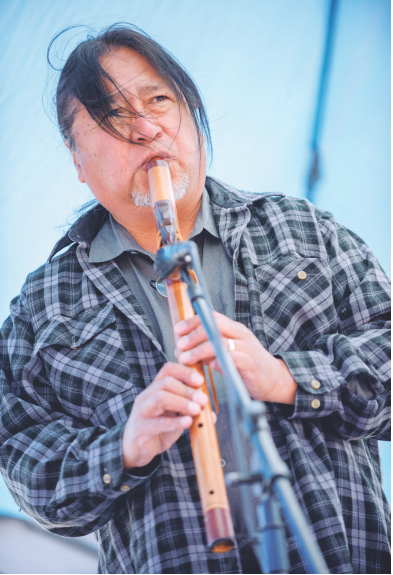
NAVAJO TIMES | PHOTOS BY ADRON GARDNER
Jazz flutist Gary Vince Redhorse plays “Miss You” by the Rolling Stones during the 9th Annual Zoo Fest at the Navajo Nation Zoo in Window Rock Saturday.